
Why Digital Engineering and AI are the Navy’s ROI Engine

By Aaron Wagner, Chief Strategy Officer, Integer Technologies
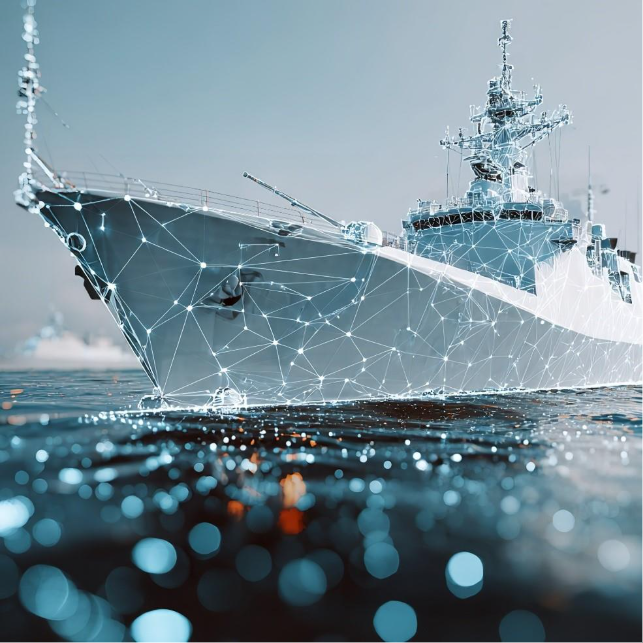
Last November, the U.S. Navy made a consequential decision: it cancelled the Constellation-class frigate program after years of delays, design churn, and mounting costs, even though two ships are already partially built.
In a statement, Navy Secretary John C. Phelan said, “A key factor in this decision is the need to grow the fleet faster to meet tomorrow’s threats. … The facts are clear. It is time to deliver the ship our warfighters need at a pace that matches the threat environment, not the comfort level of the bureaucracy.”
Programs that move too slowly and consume too many resources without delivering timely value will no longer be allowed to continue on inertia alone. This concept extends beyond just this one frigate program. It is a broader signal that the Navy intends to work faster, demand efficiency, and avoid long-term waste.
This mindset was a primary theme at the Surface Navy Association National Symposium (SNA ‘26) recently in Arlington, Va. While the tone was notably more energized, it came with a sharpened expectation for industry: capability must now be paired with clear, defensible ROI.
Lessons from Replicator and the Cost Reality Check
SNA ‘26 also surfaced lingering uncertainty around the success of recent initiatives like Replicator, an ambitious effort to field large numbers of low-cost autonomous drones that struggled to meet its goals. By late last year, production delays and software integration issues slowed the effort.
One lesson from Replicator was that low cost and rapid fielding alone do not guarantee value. The Navy’s current focus on ROI reflects this learning, emphasizing that investments should clearly reduce long-term costs, cycle time, and operational risk, not just abstractly promise efficiency.
BBG(X) Relief, Not Reinvention
While the Navy has signaled that slow, over-budget programs are no longer acceptable, the Navy’s proposed future surface combatant concepts like the BBG(X) guided-missile battleship demonstrate that high cost alone is not the only determining factor of a program’s viability or advancement.
Large surface combatants are, by definition, the opposite of attritable platforms. Concepts like BBG(X) suggest the Navy is examining ways to build upon years of investment in power, energy, weapons, and combat systems into a single platform. Incorporating technologies and lessons from DDG development carries the hope of minimizing future cost and reducing long-term program risk.
One of the signals from the conference was appreciation regarding the future of large surface combatants and the Navy intent to capitalize on investments already made. The years’ worth of progress on these systems is expected to transition forward, even as platforms evolve.
Why This Matters for Digital Engineering and AI
This discussion doesn’t end after design and development. Ensuring that the value of a platform is realized and protected once deployed is equally important. Taken together, the lessons from cancelled programs and the continuity promised by BBG(X) point to a common requirement that the Navy must be able to measure, predict, and manage ROI across a platform’s entire lifecycle.
Navy leaders emphasized the need for deployed platforms that can survive missions and adapt without costly rework or premature replacement. Digital engineering, digital twins, and AI-enabled system intelligence are no longer just tools to speed up the development process. They are crucial for continuing to reduce risk and extend system life once fielded.
However, not all digital twins are created equal. Let’s not conflate traditional digital twin models that use basic data analytics with more sophisticated versions. Traditional models are static and lack the flexibility in complex battlespaces, simply following preset instructions and incapable of adapting in real-time.
Integer’s DIGIT Mission Assurance Platform takes it a step further by combining our physics-based models and AI models to ensure human operators and autonomous systems make better decisions, faster, that are rooted in realized conditions and circumstances.
For example, Integer’s predictive power and energy management systems offers high-speed decision aids to Navy ship operators, leveraging predictive digital twins which Integer refers to as “decision aids” to create virtual representations of the vessel’s complex systems. This helps manned and unmanned ships manage power generation, fuel usage, and energy storage, enhancing performance, resilience, and efficiency while also detecting anomalies. For these systems, we’re deploying agentic AI to consume the vast amount of information on a shipboard power system, much faster than a human could work. The AI agent can understand the complex relationship between it all, assess a situation, and recommend how to reconfigure the power system to optimize mission success. A traditional operating procedure may fail here, because it’s predictive models, if they exist, are not adapting to real-time situations.
Integer’s DIGIT software understands current and projected future conditions and asset performance and their impacts on the mission. By monitoring and predicting future system health in real time, operators can complete missions without losing critical capability, reducing the need for emergency repairs.
Bottom line: Greater predictive power means more reliable platforms with fewer failures, longer system life, and less unplanned replacement. That is ROI the Navy can measure.
Read more from our Director of Digital Engineering TJ McKelvey on how our team delivered ship-level Integrated Power System digital twins in just 80 days for a Navy surface combatant, modeling real operational power demands in this article.